

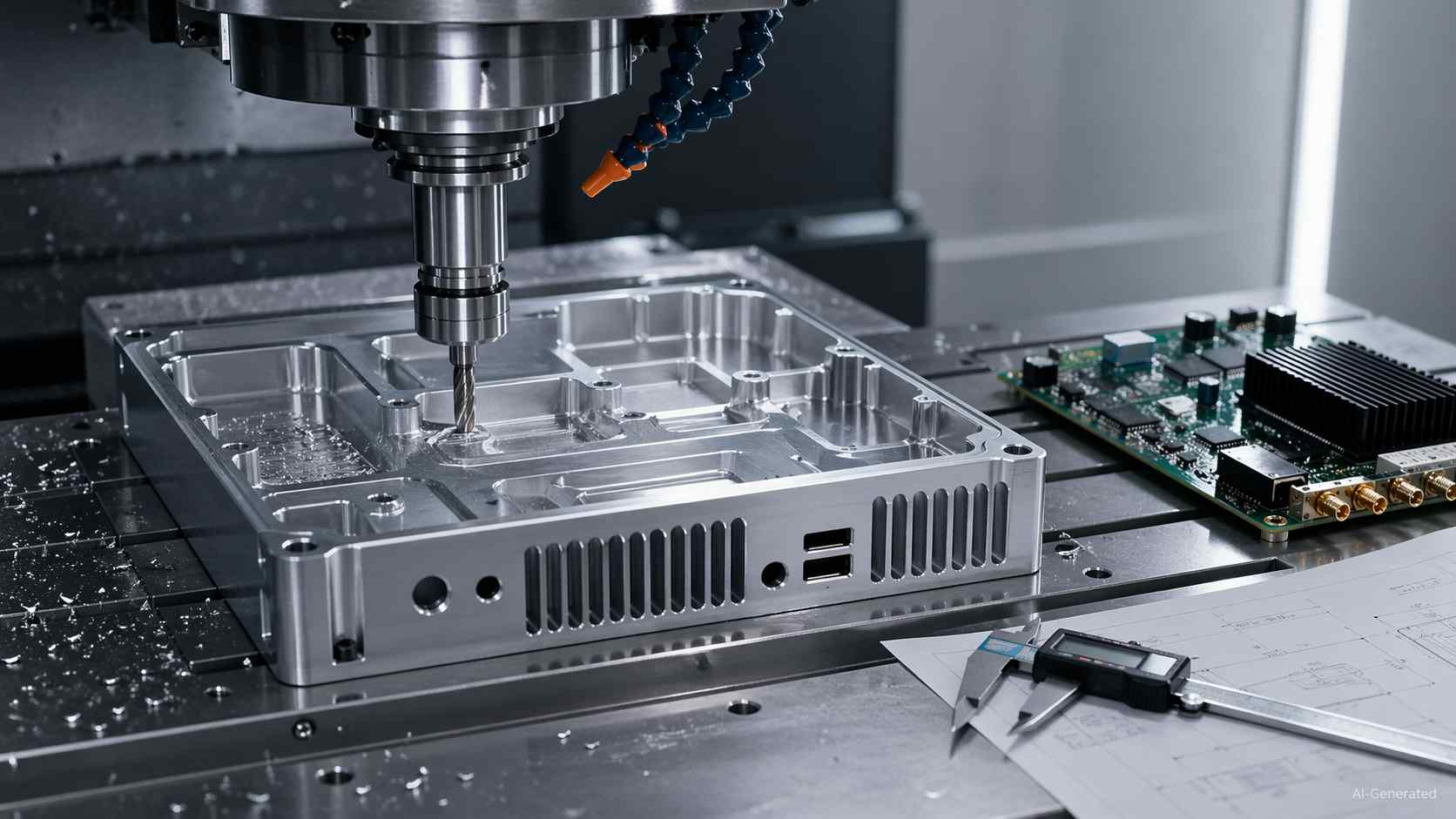
Electronic hardware is everywhere. It sits inside the smartphone in your pocket, the medical monitor in a hospital room, the navigation system in your car, and the communication equipment that keeps global networks running. Most people never see the individual components that make these devices work. They see the screen, the casing, the user interface. But beneath the surface, there are hundreds of small, precisely machined parts that determine whether the device performs reliably or fails in the field.
These parts—connector pins, sensor housings, RF shielding components, heat sinks, probe pins, and structural brackets—are the unsung foundation of modern electronics. They must meet tolerances measured in microns, maintain signal integrity, and function reliably across temperature extremes, vibration, and millions of operating cycles. Producing them at scale requires a manufacturing capability that goes far beyond standard machining. It requires precision CNC machining, and increasingly, it requires the unique advantages of Swiss-type turning.
Why Electronic Hardware Components Demand Exceptional Precision
Electronic hardware components are not like general-purpose machined parts. They operate in an environment where small deviations can have large consequences. A connector pin that is a few microns out of tolerance can fail to mate properly, causing intermittent signal loss. A sensor housing with a rough surface finish can trap contaminants or interfere with calibration. A heat sink with inconsistent flatness can fail to dissipate heat effectively, leading to premature component failure.
The materials used in electronic hardware also present unique challenges. Copper and brass alloys offer excellent electrical and thermal conductivity but are gummy and prone to producing long, stringy chips during machining. Stainless steel provides corrosion resistance and strength but work-hardens rapidly if cutting parameters are not precisely controlled. Aluminum is lightweight and machinable but requires high-speed cutting with careful chip management to avoid surface defects. Engineering plastics such as PEEK and Ultem are used for insulators and low-friction components but demand sharp tooling and controlled cutting temperatures to prevent melting or cracking.
Meeting these requirements consistently is not simply a matter of purchasing advanced machines. It requires documented process knowledge, disciplined quality systems, and the kind of accumulated experience that only comes from years of producing electronic hardware components for demanding industries. For companies sourcing these parts, the choice of manufacturing partner has direct implications for product reliability, time-to-market, and total cost.
The Swiss Machining Advantage for Electronic Components
Among precision machining technologies, Swiss-type turning has become the preferred process for many electronic hardware components. Originally developed for watchmaking, Swiss machines feed material through a guide bushing positioned immediately next to the cutting tool. Unlike conventional lathes where the workpiece extends unsupported from the chuck, this design keeps the material rigid throughout the cut. The result is the ability to hold tolerances that would otherwise be impossible on long, slender parts.
For electronic hardware, this mechanical advantage translates directly into design freedom. An engineer designing a miniature connector can specify a slender pin with multiple diameters, a threaded section, and a cross-drilled hole—features that would be difficult or impossible to produce accurately on a conventional lathe. Swiss machines can hold tolerances down to ±0.005 millimeters on diameters and true positions along the entire length of a component. They can produce parts as small as 0.5 millimeters in diameter with features measured in microns.
Modern Swiss machining centers integrate turning, milling, drilling, and threading in a single setup. This “done-in-one” approach reduces handling errors, shortens production cycles, and ensures that critical features stay aligned. For electronic components where signal integrity depends on precise geometry, this integration is not a convenience—it is a requirement. Working with a partner that has mastered Swiss CNC machining allows electronics manufacturers to achieve the precision their designs demand without sacrificing production efficiency.
The Components That Make Electronics Work
The range of electronic hardware components produced by precision CNC machining is remarkably broad. Connector pins and sockets must maintain precise diameters and surface finishes to ensure reliable mating and low contact resistance. RF shielding components must be machined to exact dimensions to block electromagnetic interference without adding unnecessary weight. Heat sinks and thermal management components must achieve flatness and surface finish specifications that ensure efficient heat transfer from sensitive electronics.
Sensor housings and detector components often require complex internal geometries, hermetic sealing surfaces, and biocompatible materials for medical or wearable applications. Probe pins used in semiconductor testing must maintain precise dimensions across millions of contact cycles. Structural brackets and mounting hardware must combine lightweight design with sufficient rigidity to protect delicate internal components from vibration and shock.
Each of these applications places distinct demands on the machining process. A component that works perfectly in a consumer device may fail in an aerospace or medical application where reliability standards are far more stringent. Suppliers who serve multiple industries develop process libraries that capture the optimal parameters for each material, geometry, and tolerance requirement. This accumulated knowledge is what separates manufacturers who can deliver consistent quality from those who struggle with variability.
Swiss-Machined Components in Critical Electronic Applications
The output of these precision processes is a family of parts that rarely get noticed but make modern electronics possible. High-quality Swiss machined components exhibit concentricity, straightness, and surface finish that engineers can trust across production runs of hundreds of thousands of units. They fit precisely, conduct signals reliably, and withstand the thermal and mechanical stresses of real-world operation.
In medical electronics, these components appear in diagnostic equipment, implantable devices, and surgical instruments. In telecommunications, they enable the connectors and RF components that keep networks running. In automotive electronics, they support sensor systems, control units, and the growing array of electronic features in modern vehicles. In industrial automation, they provide the precision interfaces that keep robotic systems and production equipment operating accurately.
The common thread across all these applications is the need for consistency. A component that meets specifications on the first article but drifts on the thousandth is not acceptable. A supplier who cannot provide full material traceability cannot serve regulated industries. A manufacturer who has not invested in process controls cannot absorb demand fluctuations without compromising quality. These are the realities that procurement professionals and engineering leaders must consider when selecting a machining partner.
From Prototype to Production: Reducing Risk Through Continuity
The journey from prototype to full-scale production is where many manufacturing partnerships fail. A shop that produces a perfect first article may struggle when orders scale to tens of thousands of units. Processes that worked at low volume may not hold tolerances when cycle times compress and tool wear accelerates.
Integrated manufacturers eliminate this discontinuity by applying the same process discipline at every stage. They support customers through the entire product lifecycle, applying consistent tooling strategies, quality standards, and inspection protocols whether the order is for ten parts or ten thousand. This continuity is particularly valuable for electronic hardware components, where the transition from prototype to production often involves changes in machining strategy, material sourcing, and quality verification.
Automation extends these capabilities further. Automated bar feeders enable lights-out operation, maintaining production around the clock with minimal supervision. In-process probing verifies dimensions between cycles, allowing the machine to compensate for tool wear automatically. For high-volume electronic components such as connector pins and sensor housings, this capability is essential for meeting cost targets without compromising quality.
Quality Systems and Traceability for Electronic Hardware
In the electronics industry, quality is not just about inspection—it is about documentation. OEMs and their suppliers require full material traceability from incoming certification to finished component. Every batch of raw material must be verified against its mill certificate, and every part must be traceable back to that original material.
Shops that serve the electronics sector maintain rigorous quality systems aligned with ISO 9001 and, for automotive electronics, IATF 16949. They perform in-process inspections, track statistical process control data, and provide first-article inspection reports upon request. Full material traceability provides the audit trail that regulated industries demand. For buyers, working with a certified supplier reduces risk and simplifies compliance.
Looking Ahead: The Strategic Value of Precision Machining Partnerships
The electronics industry continues to push toward smaller, faster, and more capable devices. Wearable technology, implantable medical devices, 5G infrastructure, and automotive electronics all demand components with tighter tolerances and higher reliability than ever before. Meeting these demands will require manufacturing capabilities that can hold precision at scales that were once considered theoretical.
For manufacturers and procurement professionals, the question is not whether to source precision-machined electronic hardware components—it is who to trust with the work. The right partner brings not just equipment but documented material expertise, proven process discipline, and the quality infrastructure that regulated industries require. They understand that copper and brass require different handling than stainless steel, that thin-walled components demand careful control of cutting forces, and that consistency across production runs is the foundation of trust.
In an era where every component matters, precision CNC machining has become a strategic capability that determines which electronic products perform as designed and which fall short. The companies that secure partnerships with manufacturers who have made the long-term investments in precision will be better equipped to navigate product complexity, respond to demand fluctuations, and bring their innovations to market. Those that treat component sourcing as a commodity transaction will face higher costs, longer lead times, and greater risk.
The electronic hardware revolution is not just about circuits and software. It is about precision—the ability to shape metal and plastic into components that meet exacting specifications, reliably, at scale. And the manufacturers who have mastered that precision are the ones leading the industry forward.
