

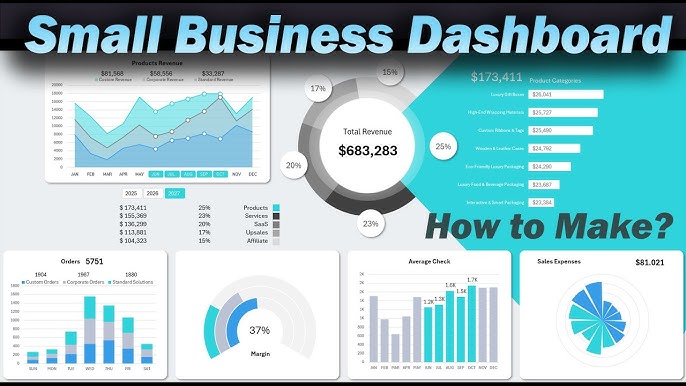
In modern business, what gets measured gets managed. Many entrepreneurs and business owners work hard every day but still struggle to understand whether their efforts are actually producing results. The missing link is often not effort, but visibility.
A business dashboard solves this problem by turning scattered data into clear insights. Instead of guessing how your business is performing, you can see everything in one place. Revenue, customer growth, expenses, conversion rates, and operational efficiency all become visible through key performance indicators, commonly known as KPIs.
A simple business dashboard does not need to be complex or expensive. In fact, the most effective dashboards are often the simplest ones. They focus only on the metrics that truly matter and remove unnecessary noise.
Whether you are running a startup, scaling a company, or managing compliance structures such as a registered business address for your legal entity, a well-designed dashboard helps you stay in control of performance and direction.
This guide will show you how to build a simple business dashboard that tracks your KPIs effectively and helps you make better business decisions.
Why a Business Dashboard Matters
Most businesses fail not because they lack data, but because they lack clarity. Data is often scattered across different tools, spreadsheets, and platforms. Without consolidation, it becomes difficult to understand what is actually happening in the business.
A dashboard solves this problem by centralizing key information into a single view.
Instead of checking multiple reports, you can instantly see how your business is performing. This allows faster decision-making, better forecasting, and improved accountability.
For example, even operational components like maintaining a registered business address may not directly generate revenue, but they are still part of your compliance and business structure. A dashboard helps you ensure that such responsibilities are tracked alongside financial and operational KPIs.
Understanding What KPIs Really Are
Key Performance Indicators are measurable values that show how effectively a business is achieving its goals.
Not all metrics are KPIs. A KPI is only meaningful if it directly reflects business performance or progress toward a goal.
For example, website traffic might be a metric, but conversion rate is a KPI because it reflects actual business outcomes.
Common KPIs include revenue growth, customer acquisition cost, profit margins, churn rate, and customer lifetime value.
The goal of a dashboard is not to track everything, but to track what matters most.
Choosing the Right KPIs for Your Business
Before building a dashboard, you need to decide which KPIs are most important for your business model.
Different businesses require different metrics. A SaaS company will focus on retention and recurring revenue, while an e-commerce business may focus on sales volume and conversion rates.
Service-based businesses may track client acquisition, project completion rates, and customer satisfaction.
Even administrative and structural elements such as maintaining a registered business address play a role in compliance tracking and operational stability, especially for companies operating across multiple jurisdictions.
The key is to focus on a small set of meaningful KPIs that reflect real performance.
Keeping Your Dashboard Simple
One of the biggest mistakes beginners make is overcomplicating their dashboards. They try to include too many charts, metrics, and data points.
A simple dashboard is far more effective because it highlights what truly matters.
The best dashboards are easy to read at a glance. Within seconds, a business owner should be able to understand performance trends.
Simplicity improves decision-making speed and reduces confusion.
Even when tracking operational elements like a registered business address, simplicity ensures that compliance and administrative tasks do not get lost in unnecessary complexity.
Collecting the Right Data Sources
A dashboard is only as good as the data behind it. Before building your dashboard, you need to identify where your data comes from.
This may include accounting software, sales platforms, website analytics tools, CRM systems, or spreadsheets.
The goal is to ensure that all relevant data is accurate and consistently updated.
Poor data quality leads to misleading insights, which can negatively impact decision-making.
Businesses with structured operations, including those managing a registered business address for compliance purposes, often benefit from organized data systems because they ensure consistency across departments.
Choosing a Dashboard Tool
There are many tools available to build business dashboards, ranging from simple spreadsheets to advanced analytics platforms.
The choice depends on your business size, technical ability, and budget.
Spreadsheets like Excel or Google Sheets are often enough for small businesses. They are flexible, easy to use, and widely accessible.
More advanced tools offer automation, integration, and real-time updates, which are useful for scaling businesses.
The key is not the tool itself, but how effectively it displays your KPIs.
Designing a Clear Layout
Good dashboard design focuses on clarity and readability. Information should be structured in a way that makes it easy to interpret.
Important KPIs should be placed at the top or in prominent positions. Supporting metrics should be placed below or in secondary sections.
The goal is to guide attention toward the most important data first.
A clean design reduces cognitive overload and improves understanding.
Even operational compliance details like updates related to a registered business address can be placed in a dedicated section so they do not interfere with core performance metrics.
Tracking Financial Performance
Financial KPIs are the backbone of any business dashboard. They show whether the business is profitable, sustainable, and growing.
Key financial indicators may include revenue, profit margins, cash flow, and expenses.
Tracking these metrics consistently helps business owners make informed financial decisions.
Without financial visibility, it becomes difficult to plan growth or manage risks effectively.
Financial data also helps evaluate whether operational costs, including those associated with a registered business address, are justified within the overall business structure.
Monitoring Customer Performance
Customer-related KPIs are essential for understanding how well your business is serving its market.
These may include customer acquisition rate, retention rate, churn rate, and customer satisfaction scores.
Strong customer performance usually indicates healthy business growth.
Weak customer performance often signals underlying issues in product quality, service delivery, or communication.
By tracking these metrics in a dashboard, businesses can identify problems early and take corrective action.
Measuring Marketing and Sales Performance
Marketing and sales KPIs help businesses understand how effectively they are attracting and converting customers.
These may include lead generation, conversion rates, cost per acquisition, and return on marketing investment.
Without these metrics, businesses often spend money on marketing without knowing whether it is effective.
A dashboard makes performance visible and allows for continuous optimization.
Even businesses that operate with structured setups such as a registered business address benefit from marketing insights because they help align operational growth with market demand.
Automating Data Where Possible
Manual data entry can be time-consuming and prone to errors. Automation helps solve this problem by connecting tools and updating dashboards in real time.
Automation reduces workload and improves accuracy.
It also ensures that decision-makers always have access to up-to-date information.
For growing businesses, automation becomes essential as data volume increases.
Even administrative updates related to a registered business address can be tracked more efficiently when integrated into automated systems.
Reviewing Your Dashboard Regularly
A dashboard is not a one-time project. It must be reviewed regularly to remain useful.
Regular reviews help business owners identify trends, adjust strategies, and improve performance.
Without regular review, even the best dashboard becomes outdated and irrelevant.
Most successful businesses review their dashboards weekly or monthly depending on their operations.
Consistent review ensures that decisions are based on current data rather than assumptions.
Turning Data Into Action
The purpose of a dashboard is not just to display data but to drive action.
Every KPI should lead to a decision or improvement.
For example, if customer churn is increasing, the business should investigate and fix the underlying issue.
If revenue is declining, marketing or sales strategies may need adjustment.
A dashboard becomes powerful only when it influences real business decisions.
Even operational insights such as updates related to a registered business address should lead to action when compliance or structural changes are required.
Conclusion
A simple business dashboard is one of the most powerful tools for managing and growing a business. It transforms complex data into clear insights and helps business owners make better decisions with confidence.
By focusing on the right KPIs, keeping the design simple, and ensuring accurate data collection, any business can build a dashboard that improves performance and clarity.
Whether you are running a startup or managing a structured organization with elements like a registered business address for compliance and legal operations, a dashboard ensures that every part of your business is visible and measurable.
Ultimately, what you measure determines what you improve. A well-designed dashboard ensures that your business is always moving in the right direction.
FAQs
What is a business dashboard
A business dashboard is a visual tool that displays key performance indicators to help business owners monitor and analyze business performance in one place.
Why are KPIs important in business
KPIs are important because they measure how effectively a business is achieving its goals and provide insights for better decision-making.
How many KPIs should a dashboard include
A dashboard should include only the most important KPIs. Too many metrics can create confusion and reduce clarity.
What tools can I use to build a business dashboard
Common tools include Excel, Google Sheets, and advanced analytics platforms depending on business size and needs.
How does a registered business address relate to a dashboard
A registered business address is part of business compliance and structure. Tracking it within operational systems ensures proper governance and organization.
How often should a business dashboard be updated
Dashboards should be updated regularly, either weekly or monthly depending on how fast the business operates.
What makes a good business dashboard
A good dashboard is simple, clear, focused on important KPIs, and easy to understand at a glance.
You should also read: TechAiTech
